Update 2024-10: The Policy Maker is the winner of the 2024 International Educational Games Competition, student games category! Read more
In The Policy Maker, an educational board game for 3 to 4 players, complex interplay of political decisions and financial interests are made tangible and approachable through gameplay.
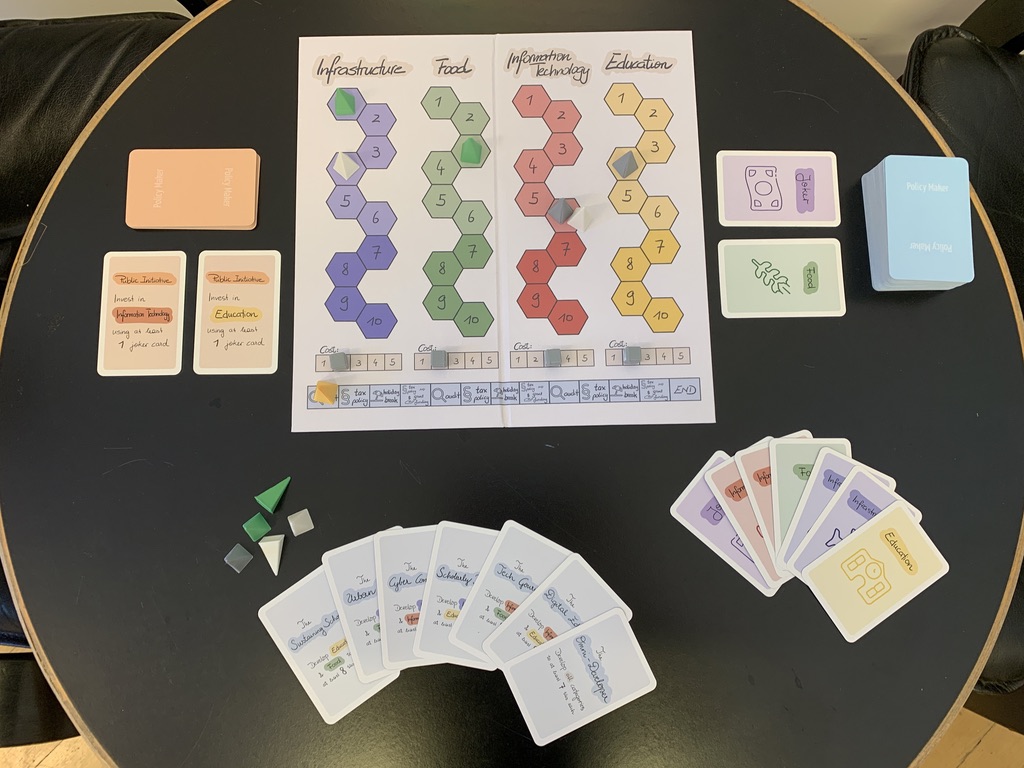
Gameplay
In this asymmetrical game, one player assumes the role of the Policy Maker (PM) and the others play as investors. The goal for the investors is to establish a monopoly in one of four business sectors; the PM follows the diametrically opposite goal of preventing these monopolies, in addition to ensuring economic progress.
Investors use investment cards to expand their market standing in the four business sectors and establish a monopoly in one of these. They can use their resources to manipulate the market – setting other investors back, and fulfill public initiatives to gain additional investment cards. On the other side, the PM engages in different policy actions (tax adjustment, grant funding, audit), trying to balance the market.
Learning
By interacting within the game, players experience the constant negotiations between political and financial institutions. The PM takes actions that influence the market both directly and in the long-term. The investors adapt their plans and experience what it is like to pursue different goals in the same given system, reacting to changes in the political frame and each others’ moves. At the same time, the PM learns to observe the dynamic market, to plan ahead and effectively achieve their development goal.
The importance and far-reaching consequences of policies is transferred in a simple and understandable gameplay, inviting players to think about real-life occurrences of such political and economic events.

Background and Application
The game was designed in the 2023 summer semester, as course work for the course Gameful Design at TU Wien, by Victoria Fischer and Shuyin Zheng, under the guidance of Naemi Luckner and Peter Purgathofer. The goal was to create a game that can enhance learning in the topic of Policy Thinking, as part of the course Denkweisen der Informatik (eng.: Ways of Thinking in Informatics), a first-semester course for Computer Science students at TU Wien.
The game has received excellent feedback from student players. A related case study has been published in 2024: https://doi.org/10.34190/ecgbl.18.1.2709.
The rules have since been updated in September 2024. The new version of the game will be used in upcoming iterations of the course Denkweisen der Informatik.
Materials
You can follow the instructions to create your own copy of the game. Please always credit Victoria Fischer and Shuyin Zheng as the creators of the game.
Instructions
Download the instructions, including description and number of cards and game pieces. Latest version updated: September 2024.
Cards
You can print the cards from Cards.pdf. If possible, to make distinguishing the cards easier while playing, the “public initiative” cards should have an orange card back; the “policy goal” cards should have a black card back; the investment cards can have whatever (but the same) card back.
Alternatively, you can use cards from games such as UNO as investment cards – each color corresponds to one business sector of the game, black cards are joker cards. In this case, use the right amount of cards as described in the instructions document.
Game Pieces
As described in the instructions, to play the game you need:
- 3x sets of 4x investor stones of the same color
- 1x timeline marker (Policy Maker stone)
- 4x costs stones (can be the same color)
You can use any game pieces you have, as long as they are distinguishable from each other.
Game board
Use at least ~A3 size for the game board, choose between a rectangular or a square layout.
 Shuyin Zheng